Free K-3 Hands-On Lesson Plan
Math Adventures: Everyday Numbers — printable PDF with 10 hands-on activities your kids will love.
Montessori homeschool activities by age offer a structured yet child-centered approach to learning that honors each child’s natural development and curiosity. This educational philosophy, developed by Dr. Maria Montessori, emphasizes hands-on learning, independence, and respect for a child’s natural psychological development, making it an ideal framework for homeschooling families seeking a gentle yet academically rigorous approach.
Whether you’re new to homeschooling or considering incorporating Montessori principles into your existing curriculum, understanding age-appropriate activities is crucial for success. This comprehensive guide will walk you through specific Montessori activities tailored to different developmental stages, from toddlers to elementary-aged children, providing you with practical tools and insights to create an engaging learning environment at home.
Key Takeaways
- Montessori activities are designed around natural developmental stages and sensitive periods
- Each age group requires specific materials and approaches to maximize learning potential
- Independence and self-directed learning are core principles across all age levels
- Practical life skills form the foundation of Montessori education at every stage
- Mixed-age groupings and peer learning enhance the Montessori homeschool experience
Understanding Montessori Principles for Homeschooling
Before diving into specific Montessori homeschool activities by age, it’s essential to understand the foundational principles that guide this educational approach. The Montessori method is built on scientific observations of children’s natural learning processes, emphasizing respect for the child as an individual capable of initiating their own learning.
The concept of “sensitive periods” is central to Montessori education. These are windows of opportunity when children are naturally drawn to specific types of learning. According to the Department of Education, children learn most effectively when activities align with these developmental windows.
Core Montessori Principles
The prepared environment serves as the third teacher in Montessori education, alongside the child and the adult guide. This environment should be carefully curated with materials that are beautiful, purposeful, and accessible to children at their developmental level.
- Child-sized furniture and materials promote independence
- Natural materials engage the senses and connect children to their environment
- Order and beauty create a calm, focused learning atmosphere
- Freedom within limits allows children to make choices while maintaining structure
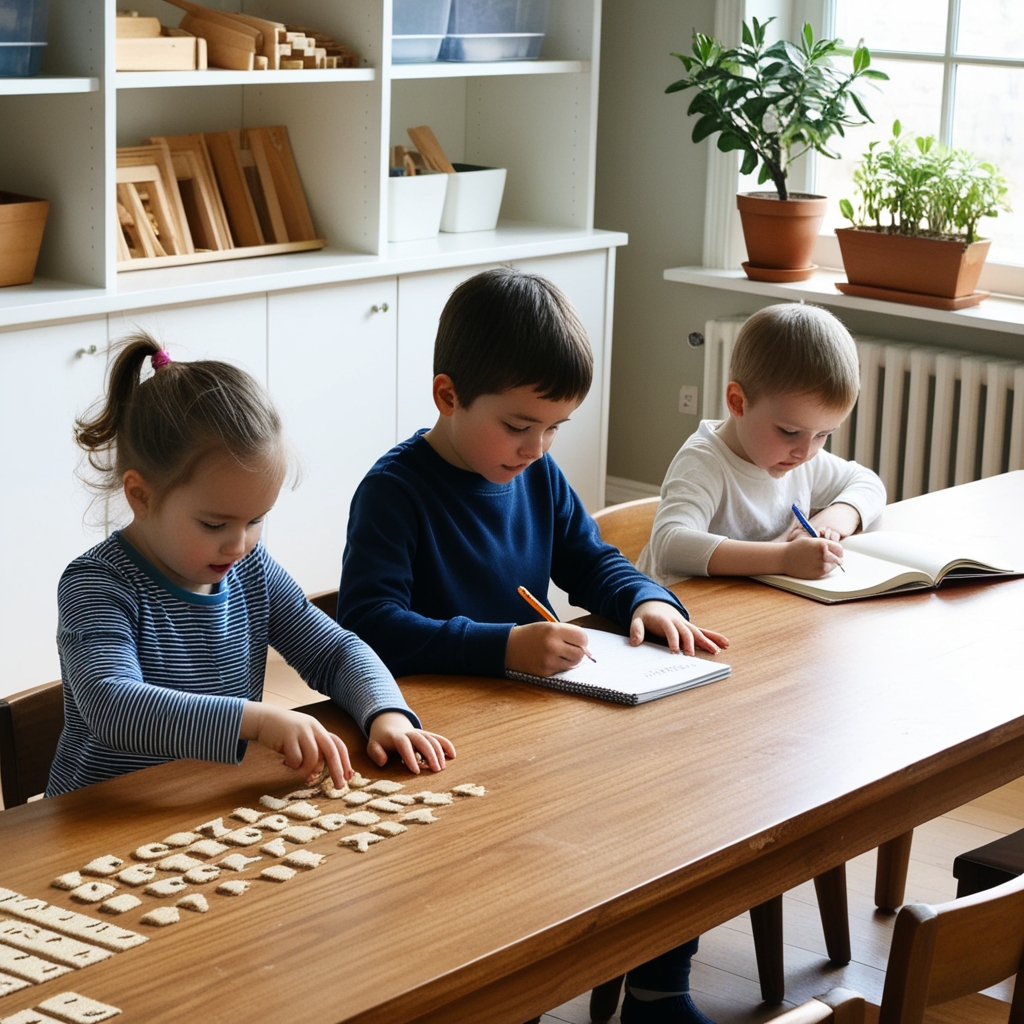
Mixed-age groupings, typically spanning three years, allow younger children to learn from older peers while giving older children opportunities to reinforce their learning through teaching. This natural mentoring system strengthens the learning community and builds confidence across age groups.
Montessori Activities for Toddlers (18 months – 3 years)
Toddlers are in a critical period for language development, movement refinement, and establishing independence. Montessori homeschool activities for this age group focus heavily on practical life skills, sensory exploration, and language development through rich experiences rather than formal instruction.
Practical Life Activities for Toddlers
Practical life forms the cornerstone of toddler Montessori education. These activities help children develop concentration, coordination, and independence while contributing meaningfully to family life.
- Food Preparation: Washing fruits, spreading butter on bread, or arranging snacks on plates
- Care of Environment: Dusting with small cloths, watering plants with tiny watering cans, or organizing toys
- Care of Self: Brushing teeth, washing hands independently, or choosing weather-appropriate clothing
- Grace and Courtesy: Learning to say “please” and “thank you,” walking carefully around others’ work, or setting the table
Sensory Development Activities
Toddlers learn through their senses, making sensory activities crucial for cognitive development. These activities should be simple, beautiful, and offer clear learning objectives.
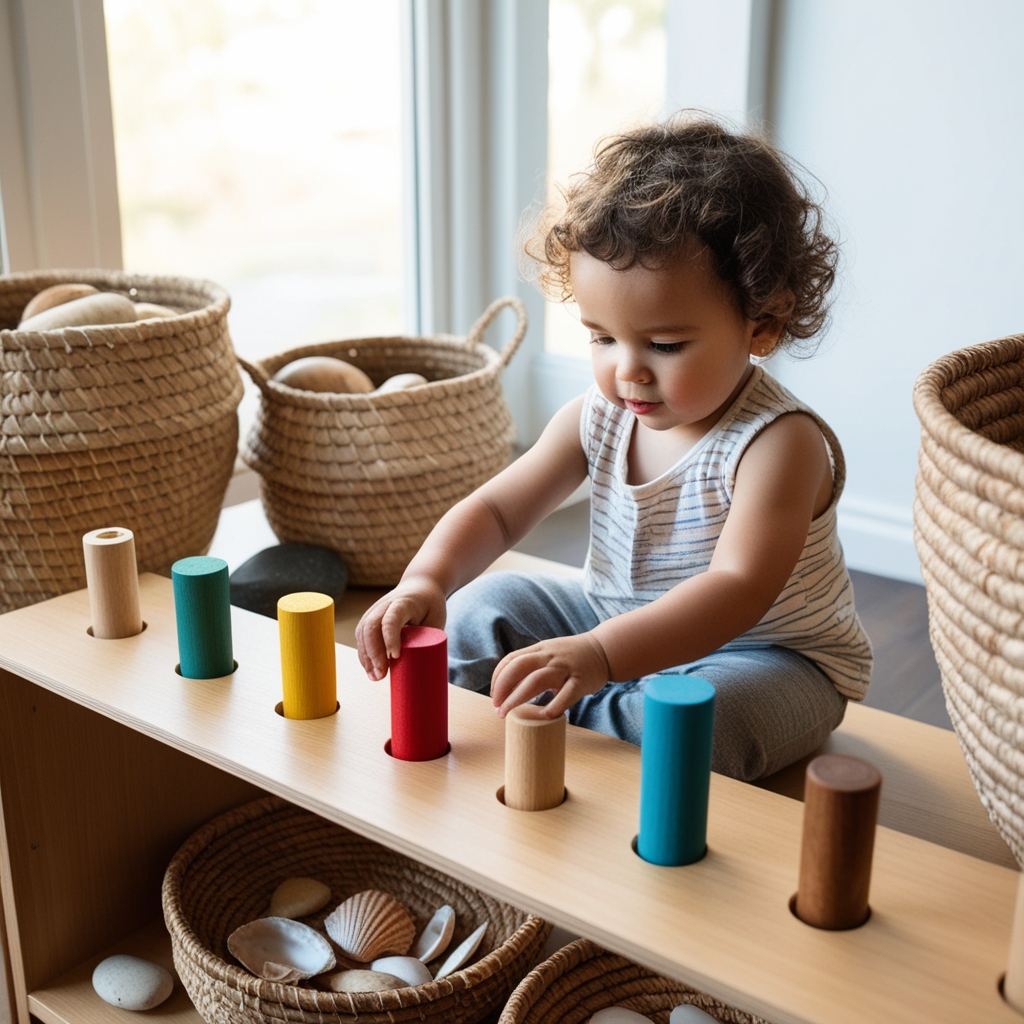
Texture baskets containing various fabrics, natural materials, and household items provide rich sensory experiences. Sound cylinders made from small containers filled with different materials help develop auditory discrimination skills.
Color sorting activities using real objects like buttons, shells, or blocks help toddlers categorize and organize their world. These activities lay the groundwork for mathematical thinking and logical reasoning.
Language Development Through Rich Experiences
Language development happens naturally through meaningful interactions and rich vocabulary exposure. Rather than flashcards or formal lessons, toddlers benefit from conversation, storytelling, and real-world experiences.
Vocabulary building occurs through three-period lessons, a Montessori technique that introduces new concepts gradually. For example, when introducing color names, you might first show and name the colors, then ask the child to identify them, and finally ask them to name the colors independently.
Preschool Montessori Homeschool Activities (3-6 years)
The preschool years represent a golden period for Montessori learning, as children are naturally drawn to order, routine, and increasingly complex activities. This age group is ready for more structured learning while maintaining the hands-on, experiential approach that defines Montessori education.
Mathematics Through Concrete Materials
Montessori mathematics education begins with concrete experiences that children can see, touch, and manipulate. The famous golden beads introduce the decimal system in a tangible way that makes abstract concepts accessible to young minds.
The number rods help children understand quantity and sequence from 1 to 10. These beautiful red and blue segmented rods provide a visual and tactile representation of increasing quantities. Children can arrange them in order, count the segments, and begin to understand mathematical relationships.
- Counting Activities: Using spindle boxes, number cards and counters, or hundred boards
- Operations Introduction: Addition and subtraction with golden beads and operation boards
- Geometry Foundations: Geometric solids, constructive triangles, and geometric cabinet
- Measurement Concepts: Comparing lengths, weights, and volumes through hands-on exploration
Language Arts Development
Montessori language education follows a carefully sequenced progression from sound awareness to reading and writing. The sandpaper letters provide a multi-sensory introduction to letter formation and sounds.
Phonetic awareness develops through games like “I Spy” with beginning sounds, sound sorting activities, and rhyming games. The moveable alphabet allows children to construct words before they can write them, separating the mental process of spelling from the physical challenge of handwriting.
Reading development occurs naturally as children combine their knowledge of letter sounds with their expanding vocabulary. Pink, blue, and green reading series provide carefully sequenced reading materials that match children’s phonetic knowledge and reading abilities.
Cultural Studies and Science Exploration
The preschool years are perfect for introducing big concepts about our world through engaging, hands-on activities. Geography begins with the child’s immediate environment and expands outward to include the world.
Puzzle maps help children understand geographical relationships and develop spatial awareness. Starting with a puzzle map of their own continent, children gradually learn about different countries, their shapes, and relative positions.
- Science Experiments: Simple investigations with magnets, floating and sinking, or plant growth
- Nature Studies: Collecting leaves, observing seasonal changes, or caring for classroom pets
- Cultural Awareness: Learning about different countries through food, music, and traditional crafts
- Time Concepts: Understanding daily routines, seasons, and basic calendar concepts
Early Elementary Montessori Activities (6-9 years)

Elementary-aged children experience a significant shift in their learning style and interests. They become more social, develop a strong sense of justice, and are capable of abstract thinking. Montessori homeschool activities for this age group reflect these developmental changes through collaborative projects, moral discussions, and introduction to abstract concepts.
The Great Lessons Foundation
Montessori elementary education begins with five Great Lessons that provide a cosmic perspective on learning. These impressionistic lessons spark children’s imagination and provide a framework for all subsequent learning.
The First Great Lesson, “The Coming of the Universe and Earth,” introduces children to the formation of our planet through dramatic storytelling and impressive demonstrations. This lesson connects to physics, chemistry, geology, and astronomy studies throughout the elementary years.
Each Great Lesson serves as a launching point for extensive research and exploration. Children naturally develop questions and interests that guide their learning journey, making education personally meaningful and engaging.
Advanced Mathematics Concepts
Elementary mathematics builds upon the concrete foundation established in the primary years. Children continue using manipulative materials while gradually moving toward abstraction.
The hierarchical material extends place value understanding into the millions. Children can physically experience the relationships between units, tens, hundreds, and beyond, making large numbers comprehensible and manageable.
- Operations Mastery: Multiplication and division with golden beads, stamp games, and bead frames
- Fractions Introduction: Fraction circles, fraction skittles, and equivalency work
- Geometry Expansion: Nomenclature cards, geometric solids studies, and angle measurements
- Problem Solving: Word problems, mathematical reasoning, and real-world applications
Research and Writing Skills
Elementary children are natural researchers, driven by curiosity about how things work and why events occur. Montessori education channels this curiosity into systematic research skills and expressive writing opportunities.
The research process begins with question formation, moves through information gathering from various sources, and culminates in presenting findings to others. This process develops critical thinking, information literacy, and communication skills essential for lifelong learning.
Writing opportunities emerge naturally from research interests. Children might write reports about their favorite animals, create timelines of historical events, or compose stories inspired by their cultural studies. The emphasis is on authentic communication rather than isolated skill practice.
Upper Elementary Montessori Learning (9-12 years)
Upper elementary students are developing stronger abstract thinking abilities and are ready for more complex projects and independent work. Montessori homeschool activities by age for this group emphasize personal responsibility, collaborative learning, and preparation for adolescence.
Independent Research Projects
Nine to twelve-year-olds thrive on long-term, independent research projects that allow them to dive deeply into topics of personal interest. These projects integrate multiple subject areas and develop important life skills.
Project-based learning might include creating a business plan for a student-run enterprise, researching family genealogy and creating a multimedia presentation, or designing and conducting scientific experiments to answer personally meaningful questions.
Advanced Academic Skills
Academic expectations increase significantly in the upper elementary years, but learning remains hands-on and personally meaningful. Mathematical concepts become more abstract while maintaining concrete connections when needed.
- Advanced Mathematics: Algebraic thinking, geometric proofs, and statistical analysis
- Literary Analysis: Reading comprehension strategies, author studies, and creative writing
- Scientific Method: Hypothesis formation, experimental design, and data analysis
- Historical Thinking: Cause and effect relationships, multiple perspectives, and timeline creation
Community Engagement and Service
Upper elementary children have a strong sense of justice and desire to make positive changes in their world. Community service projects and civic engagement activities channel these interests productively.
Service learning opportunities might include organizing food drives for local shelters, creating educational materials for younger children, or participating in environmental conservation projects. These experiences develop empathy, leadership skills, and civic responsibility.
Creating the Perfect Montessori Learning Environment
The prepared environment is crucial for successful Montessori homeschool activities by age. This environment should evolve as children grow and develop, always maintaining the principles of beauty, order, and accessibility while meeting changing developmental needs.
Physical Space Considerations
Your Montessori homeschool environment doesn’t require a dedicated classroom, but it should include specific elements that support independent learning and concentration. Natural lighting, child-sized furniture, and organized materials create an inviting learning atmosphere.
Work areas should include both table space and floor space with mats for spreading out materials. Shelving should be low and accessible, with materials arranged attractively and logically. Each material should have a designated place, making it easy for children to find and return items independently.
Material Selection and Organization
Montessori materials are specifically designed to be self-correcting, beautiful, and purposeful. While authentic Montessori materials can be expensive, many activities can be created or adapted using household items and natural materials.
Quality is more important than quantity when selecting materials. A few well-chosen, beautiful materials will serve children better than many cheap, poorly made alternatives. Materials should be complete, clean, and in good repair to maintain children’s respect and interest.
- Rotation System: Rotate materials regularly to maintain interest and challenge
- Accessibility: Ensure all materials are within children’s reach and clearly labeled
- Natural Elements: Include plants, natural light, and organic materials when possible
- Order and Beauty: Maintain organization and aesthetic appeal in all areas
Implementation Tips for Success
Successfully implementing Montessori homeschool activities requires understanding both the philosophy and practical considerations. Many families find success by gradually incorporating Montessori principles rather than attempting a complete transformation overnight.
Starting Your Montessori Journey
Begin by observing your children carefully to understand their interests, developmental needs, and learning styles. This observation will guide your material selection and activity planning more effectively than any predetermined curriculum.
Start with practical life activities, as these are often the most accessible and immediately beneficial for children of all ages. These activities require minimal special materials and provide immediate opportunities for independence and contribution to family life.
Consider exploring our comprehensive lesson plan resources to support your Montessori implementation with age-appropriate activities and guidance.
Balancing Structure and Freedom
Montessori education provides “freedom within limits,” meaning children have choices within a carefully prepared structure. This balance can be challenging for parents to maintain but is essential for success.
Establish clear ground rules for material use, work space respect, and daily routines while allowing children to choose their activities and work pace. This balance helps children develop self-discipline and intrinsic motivation while maintaining necessary boundaries.
Record Keeping and Documentation
Maintain simple records of your children’s activities, interests, and progress. This documentation helps you track learning over time and provides valuable information for adjusting your approach as needed.
Photography can be an excellent way to document learning, especially for hands-on activities that don’t produce traditional written work. Create portfolios that showcase your children’s growth and learning journey over time.
Assessment and Progress Tracking
Montessori assessment focuses on observing children’s development and learning rather than traditional testing methods. This approach provides a more complete picture of each child’s growth and helps guide future learning experiences.
Observation-Based Assessment
Regular observation is the primary assessment tool in Montessori education. Watch for signs of mastery, interest, and readiness for new challenges. Children often demonstrate their understanding through their choice of activities and their approach to problem-solving.
Look for indicators such as sustained concentration, repeated practice of skills, helping others with activities, and creative extensions of basic lessons. These behaviors indicate genuine learning and readiness for advancement.
Portfolio Development
Create portfolios that showcase your children’s learning journey through work samples, photographs, and reflection pieces. These portfolios provide concrete evidence of growth and learning for both family records and potential school transitions.
Include examples of work from all subject areas, noting dates and any relevant context. Written reflections from both parent and child add valuable perspective to the learning documentation.
Self-Assessment Skills
Encourage children to reflect on their own learning and set personal goals. This self-assessment develops metacognitive skills and helps children take ownership of their educational journey.
Regular family meetings or learning conferences provide opportunities for children to share their accomplishments, discuss challenges, and set goals for future learning. These conversations strengthen the parent-child partnership in education.
Frequently Asked Questions
What age is best to start Montessori homeschool activities?
Montessori principles can be applied from birth, but formal activities typically begin around 18 months to 2 years old. The key is matching activities to your child’s developmental stage and interests rather than focusing solely on chronological age. Toddlers benefit greatly from practical life activities and sensory exploration, which form the foundation for later academic learning.
Do I need expensive Montessori materials to homeschool successfully?
While authentic Montessori materials are beautifully designed and highly effective, many activities can be adapted using household items and DIY alternatives. Focus on the principles behind the materials rather than the materials themselves. Natural, beautiful, and purposeful items that allow for hands-on learning can be just as effective as commercial materials.
How do I handle multiple children of different ages in Montessori homeschooling?
Mixed-age learning is actually a strength of the Montessori approach. Older children reinforce their learning by helping younger siblings, while younger children are inspired by observing more advanced work. Create activities that can be adapted for different skill levels and encourage peer teaching and collaboration.
How much time should children spend on Montessori activities each day?
Quality is more important than quantity in Montessori education. Young children might engage in focused activities for 15-30 minutes, while elementary-aged children can sustain concentration for much longer periods. Follow your child’s natural rhythms and attention spans rather than imposing artificial time limits.
Can Montessori homeschooling prepare children for traditional schools?
Yes, Montessori education develops strong foundational skills including independence, critical thinking, and intrinsic motivation that serve children well in any educational setting. Children who have experienced Montessori education often adapt successfully to traditional schools, though some adjustment period may be needed for different teaching styles and expectations.
How do I know if my child is making adequate progress with Montessori activities?
Progress in Montessori education is measured through careful observation rather than traditional testing. Look for signs such as increased concentration, voluntary repetition of activities, helping others, and creative problem-solving. Children should show growing independence, confidence, and joy in learning.
What if my child resists Montessori activities or prefers traditional workbooks?
Some children may need time to adjust to the freedom and responsibility inherent in Montessori education, especially if they’re accustomed to more directed learning. Start gradually, maintain consistency, and focus on practical life activities that have immediate, obvious purposes. Most children eventually embrace the independence and choice that Montessori education provides.
Montessori at Home
As an Amazon Associate, HomeschoolingExperts earns from qualifying purchases. Some links in this article are affiliate links, meaning we may earn a small commission at no extra cost to you.
Conclusion
Implementing Montessori homeschool activities by age creates a rich, developmentally appropriate learning environment that honors your child’s natural curiosity and learning style. From toddler practical life activities to elementary research projects, the Montessori approach provides a solid foundation for lifelong learning and personal development.
Remember that successful Montessori homeschooling is more about understanding and applying the underlying principles than about having perfect materials or environments. Focus on creating opportunities for independence, hands-on learning, and meaningful choice within your family’s unique circumstances.
The journey of Montessori homeschooling requires patience, observation, and flexibility as you learn alongside your children. Trust in your children’s natural desire to learn and your ability to guide them through this beautiful educational approach.
Ready to begin your Montessori homeschooling journey? Start by implementing one or two age-appropriate activities this week and gradually expand your approach as you and your children become more comfortable with this child-centered learning style.
Related Resources
Explore these additional resources to support your Montessori homeschooling journey:
- Curriculum Methods and Approaches – Discover various homeschooling philosophies and methods
- Creative Learning Activities and Ideas – Find inspiration for hands-on learning experiences
- Grade-Level Learning Guides – Access age-specific educational guidance and milestones

Loved this post? Grab the free resource above.
Math Adventures: Everyday Numbers — printable PDF with 10 hands-on activities your kids will love.